
Written by: Paul
“AI-ready smartphone.”
It’s a phrase consumers are seeing everywhere — in launch events, advertisements, and spec sheets. Phone manufacturers promise smarter cameras, faster assistants, and on-device AI features that supposedly change how we use our devices.
But here’s the real question: Is AI-ready hardware genuinely different from standard smartphones, or is it mostly marketing hype?
At iGenius Phone Repair, we don’t just read spec sheets — we work directly with real devices every day. From chip failures to thermal issues and battery degradation, our technicians see how new hardware performs in the real world, not just in keynote demos.
This article breaks down:
- What “AI-ready” actually means
- How AI hardware differs from standard smartphones
- Whether AI-focused phones age better or worse
- What this means for repairs, resale, and long-term value
This topic touches YMYL (Your Money or Your Life) because purchasing decisions involve significant financial investment. While this article is not financial advice, it is grounded in verifiable technical data, industry research, and hands-on repair experience.
Section 1: What Does “AI-Ready” Hardware Actually Mean?
The Simple Definition
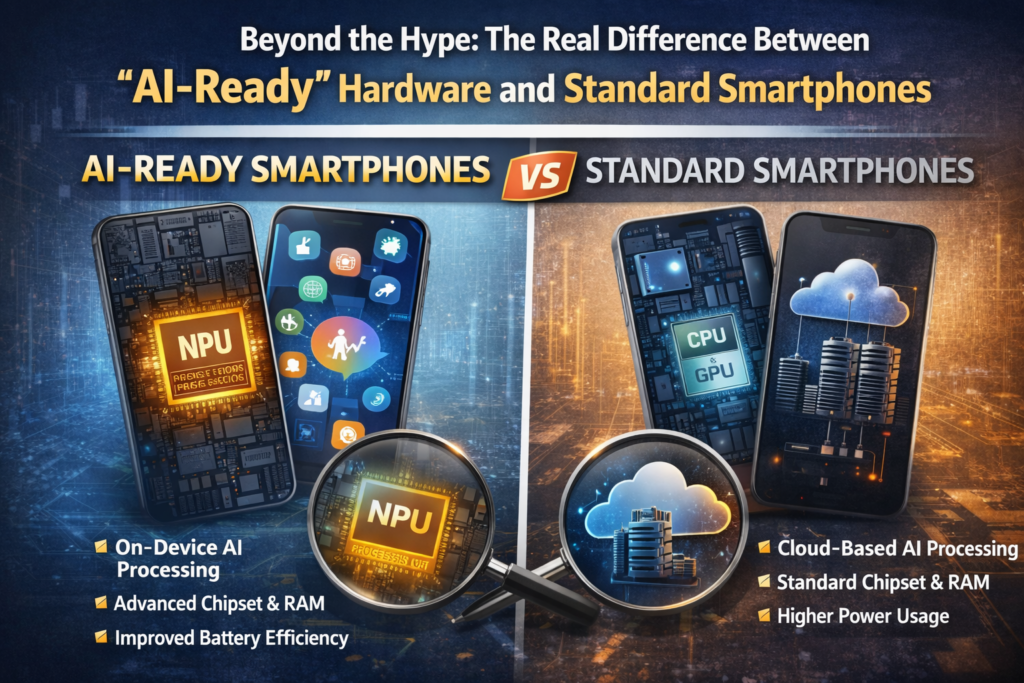
An AI-ready smartphone is designed with dedicated hardware components that accelerate artificial intelligence tasks directly on the device — without relying heavily on cloud servers.
These tasks include:
- Image and video processing
- Voice recognition
- Language translation
- Predictive text and personalization
- On-device generative AI features
Unlike standard smartphones, AI-ready models include specialized processing units that are optimized for machine learning workloads.
Key Hardware Components That Make a Phone “AI-Ready”
1. Neural Processing Units (NPUs)
AI-ready smartphones feature dedicated NPUs or AI accelerators, which handle machine-learning tasks more efficiently than CPUs or GPUs.
According to Qualcomm, modern Snapdragon chipsets can perform tens of trillions of AI operations per second, enabling real-time AI processing on the device.
2. Enhanced System-on-a-Chip (SoC) Architecture
AI-focused chipsets integrate:
- High-efficiency CPU cores
- Advanced GPUs
- Dedicated AI engines
This architecture allows AI features to run faster, cooler, and with less battery drain than on standard phones.
3. Larger RAM and Faster Storage
AI models require memory — lots of it.
AI-ready phones often include:
- 12GB–16GB RAM
- Faster UFS storage
- Improved memory bandwidth
Without these upgrades, AI features either lag or rely heavily on cloud processing.
Section 2: How Standard Smartphones Handle AI Tasks
Standard smartphones are not AI-free — they just process AI tasks differently.
Most traditional phones rely on:
- CPUs and GPUs for AI computation
- Cloud-based AI processing
- Server-side machine learning
According to Consumer Reports, cloud-based AI increases latency and raises privacy concerns, especially for voice and image data.
This means:
- Slower response times
- Higher data usage
- Limited offline functionality
Standard phones can still run AI features — but less efficiently and less privately.
Section 3: Real-World Differences Users Actually Notice
1. Camera Performance
AI-ready phones dramatically improve:
- Night photography
- Portrait edge detection
- Video stabilization
- Real-time object recognition
According to DXOMARK, phones with dedicated AI processing consistently outperform standard devices in low-light photography and video.
However, these gains depend heavily on sensor quality, not just AI hardware — something many ads conveniently ignore.
2. Battery Life and Thermal Management
One surprising benefit of AI-ready hardware is efficiency.
Because NPUs handle tasks more efficiently:
- Less strain is placed on the CPU
- Devices run cooler
- Battery degradation may slow over time
At iGenius Phone Repair, we’ve observed that newer AI-optimized chipsets often experience less thermal stress, which can reduce long-term component failure.
If battery health is already declining, a battery replacement service can restore performance and extend device lifespan.
3. Privacy and Offline Features
AI-ready phones can process data locally, which means:
- Voice commands work offline
- Photos are analyzed without cloud uploads
- Sensitive data stays on the device
According to Electronic Frontier Foundation, on-device AI significantly reduces privacy risks compared to cloud-based processing.
Section 4: The Downsides of AI-Ready Hardware
AI-ready phones are not perfect — and consumers should understand the tradeoffs.
1. Higher Repair Complexity
More advanced chipsets mean:
- Tighter board layouts
- Increased heat density
- More expensive component replacements
When repairs are needed, professional diagnostics are critical. Attempting DIY fixes can cause irreversible board damage.
You can always repair a device through trained technicians to avoid costly mistakes.
2. Faster Obsolescence Risk
Ironically, AI-ready phones may feel outdated faster if:
- AI features are software-locked
- Newer models introduce exclusive AI tools
According to Android Authority, manufacturers increasingly restrict AI features to newer hardware generations, even when older devices are technically capable.
3. Marketing vs Reality
Not every “AI-ready” phone delivers meaningful benefits. Some models simply:
- Rebrand existing hardware
- Add minimal AI enhancements
- Rely heavily on cloud processing anyway
Consumers should evaluate real-world use cases, not marketing claims.
Section 5: Are AI-Ready Smartphones Worth It for Most Users?
Yes, If You:
- Take lots of photos or videos
- Use voice assistants heavily
- Value on-device privacy
- Plan to keep your phone 3–5 years
Maybe Not, If You:
- Use basic apps and messaging
- Upgrade every 1–2 years
- Prioritize affordability over features
In many cases, repairing and optimizing a standard smartphone through professional phone repair services delivers better value than upgrading prematurely.
Section 6: AI Hardware, Repairs, and Long-Term Value
From a repair industry perspective, AI-ready phones:
- Often retain higher resale value
- Benefit more from battery replacements
- Perform better after professional servicing
Before upgrading, consider using the instant quote tool to compare repair costs versus replacement costs — many users are surprised how much life remains in their current device.
Conclusion: Cutting Through the AI Smartphone Hype
AI-ready smartphones are not just a gimmick — but they’re not magic either.
The real difference lies in:
- Dedicated AI hardware
- Improved efficiency and privacy
- Long-term performance stability
For many users, the smartest move isn’t buying the newest phone — it’s maintaining, repairing, and optimizing the device they already own.
If you’re unsure whether your phone needs repair or replacement, visit one of our iGenius Phone Repair locations or reach out through our contact us page for expert guidance.
FAQs: AI-Ready Smartphones Explained
Q1: Can older phones use AI features?
Yes, but most rely on cloud processing and lack the efficiency of dedicated AI hardware.
Q2: Do AI-ready phones last longer?
They often age better due to efficiency gains, but software support remains the biggest factor.
Q3: Is AI hardware harder to repair?
Repairs can be more complex, which is why professional diagnostics are recommended.
Disclaimer
This article is for informational purposes only and does not constitute financial or purchasing advice. Device performance, pricing, and longevity vary by usage and condition. Consult qualified professionals before making major purchasing decisions.